After all, the sales industry is the heart and blood of your business (unless you are a non-profit). The more sales you can arrange, the more growth you can expect; that is the way to go, but do not forget about sales trends.
We live in an age where new things pop up all the time. TikTok, LinkedIn marketing, and content strategies all disrupt the traditional sales process management. Keeping tabs on modern sales trend analysis is essential to remain relevant and, more importantly, competitive. We think it is unnecessary to remind you of the definition of sales trends, as all modern businesses strive to keep up with the sales industry.
However, following all the selling trends is impossible and unnecessary, as not all of them are useful in business. We took the time to gather the most important sales trends your team should leverage to deliver the best possible results. So, let’s take a look at nine popular selling trends without any further ado.
Why Understanding Sales Trends in 2026 Matters
Want your business to stay competitive in a rapidly evolving market? Then, start by learning and understanding sales trends. That's because customer expectations, buying behaviors, and digital technologies are shifting faster than ever, and companies that rely on outdated strategies risk falling behind.
By staying ahead of emerging sales patterns, such as AI-driven personalization, data-powered forecasting, and seamless omnichannel customer journeys, businesses can make smarter decisions, adapt their processes early, and unlock new growth opportunities. In short, knowing where sales are heading in 2026 isn’t just helpful; it’s a strategic advantage that shapes long-term success.
Latest Sales Trends in 2026

Capture trends, close deals faster, and drive growth
Try for freeAI-Powered Sales Becomes the Standard — Not the Future
AI is no longer an emerging trend! In 2026, it will become deeply embedded across the sales cycle. Predictive analytics, real-time deal insights, personalized outreach, automated content creation, and AI-based sales coaching are moving from “nice to have” to “must have.”
What once felt experimental or optional is shifting into everyday workflow. Predictive analytics, real-time deal insights, personalized outreach, automated content creation, and AI-based sales coaching are moving from “nice to have” to “must have” if organizations want to compete.
The impact is profound. Instead of relying purely on manual research, cold outreach, and intuition, sales teams now build their strategy around data-driven decision-making. AI can instantly identify buying signals, evaluate deal risks, surface the most promising leads, and recommend the next best actions. Reps no longer waste time guessing which prospect to contact or what message might resonate; the system guides them toward the highest-value conversations.

Another major shift is hyper-personalization at scale. AI enables messaging tailored to each buyer’s stage, needs, and interests — something nearly impossible with human effort alone. From email content to product recommendations to pricing models, AI adapts in real time based on behaviour, industry, and even intent.
Yet the rise of AI does not diminish the role of the salesperson. If anything, it elevates it. AI handles data, processes, and automation; humans bring strategic thinking, emotional intelligence, and the ability to build trust, especially in high-stakes or complex deals. The winning model in 2026 isn't “AI instead of people”, it's AI-enhanced people.
Sales reps become sharper and more informed. Managers get clearer pipeline visibility. Buyers receive better experiences. And organizations that truly embrace AI aren’t just selling faster, they’re selling smarter, more accurately, and more profitably. Here is a comparison chart where you can see the difference between sales teams with AI vs without AI.
Sales Teams with AI vs Sales Teams without AI
| Category | Sales Teams With AI | Sales Teams Without AI |
|---|---|---|
| Lead Prioritization | Automatically identifies high‑intent and high‑value prospects using behavioural and firmographic signals. | Reps manually guess which leads to focus on, often wasting time on low‑intent prospects. |
| Outreach Quality | Hyper‑personalised messages tailored to stage, behaviour, and industry at scale. | Generic outreach with lower relevance and reduced response rates. |
| Response & Follow‑up | Automated reminders and follow‑ups timed by buyer actions and engagement signals. | Follow‑ups rely on memory, task lists, and rep discipline; many opportunities go cold. |
| Sales Cycle Speed | Faster. AI predicts bottlenecks and recommends actions to unblock deals. | Slower. Delays caused by manual research, misalignment, and missed moments. |
| Deal Forecasting | Data‑driven forecasting using engagement signals, historical patterns, and risk indicators. | Forecasts based on gut feeling, subjective opinions, and spreadsheets. |
| Coaching & Training | Real‑time feedback on calls, emails, and objection handling, enabling continuous improvement. | Coaching happens occasionally and is limited by the manager's availability. |
| Productivity | Reps spend more time selling and less on admin, thanks to automated data entry and research. | Significant time is spent on manual admin, prospect research, and reporting. |
| Pipeline Visibility | Clear pipeline health scores and risk alerts derived from multiple data sources. | Limited visibility. Managers rely on self‑reported updates that may be incomplete. |
| Customer Experience | Faster responses, tailored recommendations, and proactive service. | Inconsistent buyer experience with slower response times. |
| Win Rates & Revenue | Higher. Optimisation at every step captures more opportunities and improves margins. | Lower. Lost opportunities and late or irrelevant interactions reduce conversion. |
Social Selling
The trend among businesses to use social media is growing each year. Undoubtedly, this will be the main sales trend in 2025. Why? Just take a look at Instagram. A few years ago, it wasn’t a shopping platform, but now almost anyone can sell through this app, just like on other social media platforms.
Your business can use LinkedIn or YouTube to increase brand visibility and improve B2B sales interactions. Social media, like WhatsApp, Telegram, Instagram, etc., are the best for uniting the sales and marketing teams. While one team focuses on targeting and brand identity, the sales reps deliver the best customer experience throughout the buying process. As a result, content + commerce becomes a single experience.
For brands, this means success will depend on:
- Visibility where buyers spend time
- Shoppable content
- Seamless connection between social channels and checkout
What will you get from this? Well, you will increase the number of leads and prospects. And such potential buyers are more likely to get your conversion rate higher. Consequently, the sales cycle will decrease. So, don’t miss the opportunity to influence your sales productivity and grow your business.
Just four to five years ago, LinkedIn was nothing more than a place to find work and document your experience. Today, however, it is slowly becoming a social network for customers and vendors. As a result, more and more companies share their professional content on the platform, and there’s always something educational to read.
That is why LinkedIn has proven to be an excellent platform for marketing and sales strategies in the B2B sector. Whether promoting business cases or sharing technical expertise, LinkedIn is no longer a site to find work but to drive sales and engage in social marketing. Think about it; high-profile resumes are good indirect marketing assets.
Among other sales trends, becoming a LinkedIn user will become a powerful tool. Thus, it will help you open a new world of sales growth. For example, if your company employs talent, vendors, and customers will consider the employees’ prowess. Use this as a bragging point; promote your employees just as you would encourage a business pitch.
Moreover, for B2B companies, LinkedIn is a place where prominent companies can notice you and start cooperating. Finally, reevaluate your LinkedIn activities and start social selling there.
Analytics and Flexibility
What is the fastest-growing sales trend today? There is not just one sales trend worth your attention. Sales forces usually collaborate with marketing teams, and not only so. However, the most potent and significant trend right now is predictive data. Companies spend a lot of money on data analysis, and they will continue to do so in the following year.
Next, enterprises can develop greater market flexibility by monitoring sales analytics. If you know how to use data, you will be able to adapt to changing customer demands. Sure, there is another tricky moment - the changing environment. Therefore, as business owners, you need to prioritize creativity.
Video Content
We all watch videos. While working out in the gym, going for a jog, or eating breakfast, you probably watch something on your phone. In 2021, Statista reported that we spend an average of more than 10 hours watching videos per week. No wonder. With most of us stuck at home, video content is a haven for people and businesses.
A 2022 report by Wyzowl suggests that 86% of businesses use video as a marketing tool. This was 86% in 2022 and 2021, 85% in 2020, 87% in 2019, 81% in 2018, 63% in 2017, and 61% in 2016. Many companies combine their content efforts (written and video) to maximize the effects of their marketing campaign. If you aren’t investing in video content production for some reason, you'd better start now to increase customer interactions.
Podcasts
You might be surprised, but audio content is no less popular nowadays. Instead of listening to the radio on the way to work or home, podcasts are gaining ground. The research from Demandsage is strong proof of this, as the number of podcast listeners reached 464.7 million in 2023; by 2024, this number could reach 504.9 million people worldwide.
Creating your own podcast can strengthen your connection with customers by providing them with personal content. Moreover, this content can range from introducing updates and exciting new features to telling engaging stories about your company's history and development. So, it is a very flexible platform for reaching your target audience and finding new clients for your product or service.
Not enough budget for your own podcast? No big deal. As we mentioned earlier, the podcast field is vast and diverse. You can go to Spotify and iTunes, the most significant streaming services right now, find an existing podcast and collaborate with its creators. Remember, the possibilities are endless. Create audio content that resonates with your audience, and watch it drive engagement and sales.
Delivery Speed
While conducting a sales trends analysis, we can find that fast delivery is what our customers wait for from us.
Here’s another question. How many times have you gotten frustrated over a delayed delivery? It is probably a couple of times, but not to the extent that new generations react to it. Millennials and Gen Z are far more impatient than the previous gens. The most concerning thing is that most of them are nearing their 30s and slowly becoming decision-makers.
Like it or not, your sales team needs to adapt to these changes, and the sooner you restructure your product/service delivery, the more sales you can expect. And money isn’t an issue, either, but customer service matters. On average, Millennials buy two premium-priced items a month. Therefore, if you can improve delivery times, do it now before someone else does it.
Conversational Marketing
When people think about big corporations, they imagine them as faceless personalities who don’t care about them and only want their money. However, it turns out they aren’t so faceless, and it is all thanks to conversational marketing. Nothing comes closer to personal than a good old, friendly talk between interested parties. This modern sales approach brings loyal and faithful customers and even important sales for growing business.
Having a one-to-one conversation with your customers is nothing new, but most people like the conversation to be less formal and more understandable. Today, nobody has the time to listen to long, formal discussions; people want a shotgun of facts thrown at them one by one.
Conversational marketing is a no-fluff, straight-to-the-point, and non-formal info dump. It is a technique that encourages communication where the customer isn’t intimidated to ask questions in a non-formal manner. In other words, it is a feedback-driven system that fosters higher engagement and greater loyalty, and you should employ it to boost your sales.
Interactive Content
Among other sale trends, this one can grab your attention. One of the most critical metrics in any marketing campaign is engagement. Besides, a better way to improve it is by introducing interactive content. As the Asian proverb goes, ‘Better to see something once than to hear about it a thousand times.’ The same can be applied to content.
If you allow your prospects to try out your service/product immediately, they will be more inclined to purchase it. More than 90% of buyers search for interactive content in favor of traditional formats. In other words, we are not talking about free trials; we are talking about quizzes, polls, AR ads, and 360-degree videos.
It is not about the freshness and uniqueness of such content. It’s about the connection the prospect has with your product or service. Investing in interactive content is critical. It is far more memorable and far more effective in convincing the person to use your products and services.
CRM systems
Even though companies try to reduce their expenses, they can’t scrimp when it comes to sales automation and sales analytics. That’s because CRM platforms provide effective sales organization to keep all sales in one place, and it is the biggest trend in sales.
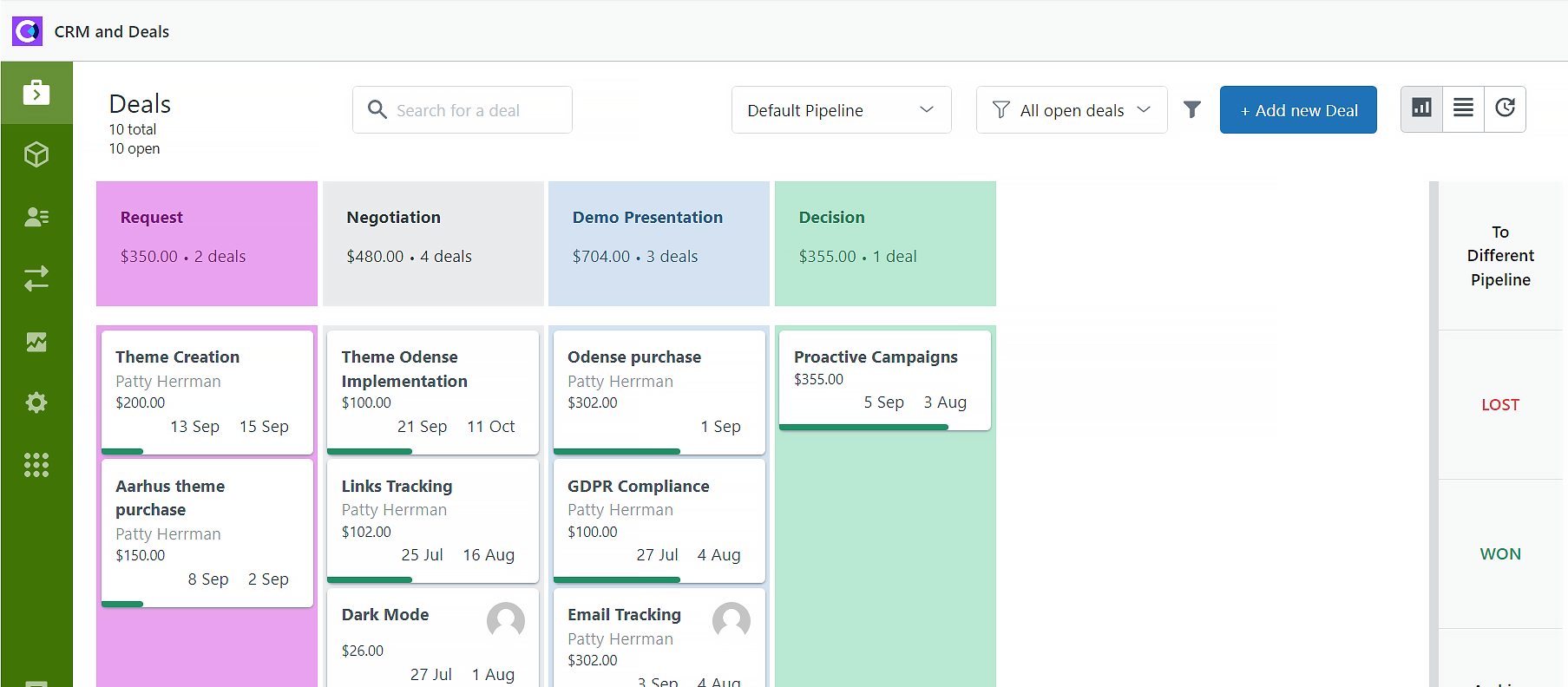
CRM (customer relationship management) is a system that helps to automate your sales process and create deals and pipelines.
What is a CRM system used for? Well, it allows you to visualize and control the movement of each deal through a sales funnel. By the way, with such a system, you can recognize the weak points of your sales pipeline and estimate what stage needs improvement. Checking your sales rep’s work is also a must, so statistics and charts are often available in CRM systems.
If you are a Zendesk user, we suggest you try the CRM and Deals app for Zendesk Support. It has all the previously mentioned features of CRMs, and it helps you successfully combine support and sales and move your contacts from tickets to deals. That’s why this is a great add-on if you are looking to integrate those two processes seamlessly.
Value-Based selling
The best piece of advice to sales representatives in 2025 is to stop moving your product to the customer at any price. The customer is no longer sensitive to words like: ‘Don’t miss the chance,’ ‘Limited offer,’ ‘An offer you can refuse,’ etc. As a result, they’ll search for a company that performs value-based selling.
What does it mean? Value-based selling is one of the new biggest sales trends when sales reps are educators. They identify the prospects’ needs, select the best solution, and tailor their product or service to personal needs. Also, they are strong experts, often certified, and know their product or service from the inside out. Besides, presenting complete information about the product is the strength of that system. As has been shown in practice, this way of sales shows much better results than aggressive sales. Thus, the process of improving sales productivity will be easier.
However, you must be sure about the quality of your product or service before implementing value-based selling. With high-quality production, you can avoid lowering the prices and giving a discount, which adversely affects your profits.
Selling - not only for sales
Keeping the strict division, such as "everyone has to do their own job," doesn't work in sales at all. Whether a web designer, an app developer, a marketer, or a support tech, everyone should feel responsible for effective selling and do their job with this idea in mind.
Undoubtedly, cross-functional collaboration and a customer-centric approach are so deeply integrated into business workflow that they no longer seem odd. But, sometimes it's useful to remind ourselves that perfect customer service should be everyone's priority, and concern not only the people in sales dep.
Each team member's contribution plays a role in shaping the customer's journey. Whether it's sophistication in design, precision in coding, strategy in marketing, or empathy in support, every aspect intertwines to create an unparalleled customer experience.
Data security
To keep up with the sales trends and the modern world in general, you should definitely keep customer data protection in mind. In our digital 21st century, people must care about their privacy more than ever before. That is why GDPR compliance is integral to all companies and organizations.
For the Zendesk platform, the easiest way to process your customer data is the GDPR Compliance app. It can anonymize, delete, or retrieve personal information upon customer request in a few clicks.
With the privacy-focused approach to your customers' data, you will build trusting and long-lasting relationships with your clients.

Comply with all GDPR requirements with ease
Get free trialHuman touch in the digital world
The last century has changed a lot by introducing technologies to humanity. With the help of the latest innovations, it's now possible to put all the sales work on ChatGPT or other machine learning apps. However, it's not a panacea.
The emphasis should be on using technology to enhance, not replace, the personal touch in sales interactions. Your customers are not robots. That's why they demand empathy and understanding.
The human touch in the digital world remains invaluable. While technology has revolutionized the way we conduct sales, it's essential to recognize that customers aren't algorithms since they crave genuine interaction.
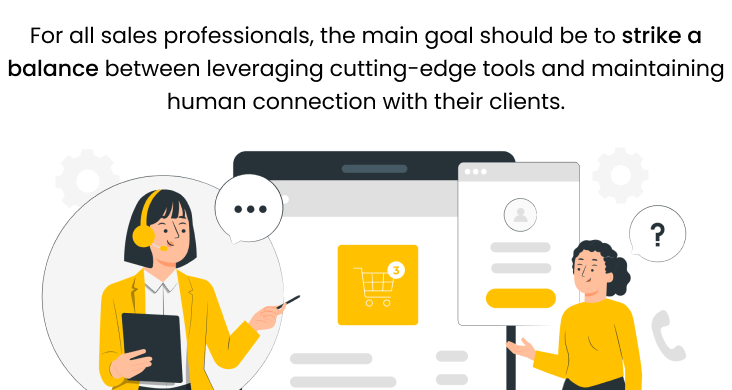
So, for all sales professionals, the main goal should be to strike a balance between leveraging cutting-edge tools and maintaining human connection with their clients.
What Is Employee-Generated Content (EGC) and Why It Matters
Employee-Generated Content (EGC) is quickly becoming one of the most influential branding and sales tools in modern business. Instead of relying solely on polished corporate marketing, companies are empowering their employees to share real stories, experiences, and expertise on their own channels. Whether it’s a LinkedIn post about a project success, a behind-the-scenes video from an office event, or a product walkthrough from a support specialist, EGC brings a level of authenticity that traditional advertising cannot match. It refers to content created by a company’s employees rather than by the marketing or communications team.
To make event-based content easier to capture and share, companies can incorporate an event photo sharing qr code, enabling employees to instantly upload photos from conferences, internal events, or team gatherings and contribute to authentic, employee-driven storytelling. This can include:
- Social media posts about workplace culture
- Product tips or tutorials made by team members
- Behind-the-scenes videos
- Blog articles or LinkedIn posts from employees
- Photos from company events, conferences, or daily work life
The Trust Advantage
People trust people. That simple truth is why employee-generated content performs so strongly. Research consistently shows that customers, job candidates, and business partners are far more influenced by the opinions and experiences of real employees than by official marketing messages. When team members openly share their achievements, lessons learned, or day-to-day insights, it humanizes the brand and builds credibility. Potential customers feel more confident when the people behind the product speak up, and potential employees get a more honest picture of what it’s like to work there.
EGC Boosts Sales, Recruiting, and Brand Visibility
The impact of EGC extends far beyond the marketing department. Sales teams benefit because prospects respond better to helpful, relatable content from employees than to scripted pitches. HR leaders benefit because job seekers are drawn to genuine stories of workplace culture rather than polished corporate career pages. And executives benefit as employee posts dramatically increase reach — leveraging the networks of hundreds of employees rather than relying solely on the company’s channels. In many cases, a single employee post can outperform a paid advertising campaign in engagement and credibility.
Why EGC Is Booming in 2026
The rise of employee-generated content is more than just a trend; it’s a response to a shift in how people consume information and make decisions. Corporate messaging is viewed with increasing scepticism, while real, relatable, and imperfect content feels more believable. At the same time, social platforms reward personal storytelling over brand promotion, making employee voices more visible and more powerful than ever. As companies focus more on authenticity, employee advocacy, and human-centred sales, EGC has become a strategic differentiator rather than a “nice-to-have.”
How Companies Can Do It Right
The most successful EGC programs are built on empowerment, not pressure. Employees need the freedom to express their perspectives in their own words and formats. Companies can support them with content prompts, workshops, templates, and internal recognition, but the tone should remain real, not scripted. When done correctly, employee-generated content becomes a virtuous cycle: employees feel valued for their voices, audiences experience more authentic storytelling, and the brand earns trust through transparency.
The Benefits of Using Sales Trends Analysis
Shifting market conditions have transformed consumer expectations and demands. As a result, sales trend analysis became the starting point in planning sales tactics. By the way, as you know, 'Who owns the information, he owns the world,' so sales trends knowledge can be helpful in:
- Planning your content strategy.
- Defining sales reps certification.
- Sales automation.
- Better performance analysis.
- Improving product quality.
- Improving delivery speed.
Sales Trends: Conclusion
The world of sales management is about to change even more. Customers are finding new contact points, employing new technology, and demanding premature deliveries. This implies changing your strategic sales approach and sales trend analysis. Addressing such needs will be challenging for simple sales teams, but they are worth the effort. But what do you think will be the 2025 most significant trends? What are your thoughts on the matter?
FAQs about Sales Trends
How do sales trends impact business strategies?
Sales trends guide businesses in making informed strategic decisions. By identifying what products, channels, and markets are performing well, companies can optimize marketing efforts, invest in high-performing segments, and improve customer targeting to stay competitive.
Why is analyzing sales trends important for companies?
Analyzing sales trends helps companies forecast demand, detect market shifts early, and minimize risks. It enables organizations to adjust their pricing, inventory, and advertising strategies based on real performance data rather than assumptions.
What role does consumer behavior play in shaping sales trends?
Consumer behavior is one of the strongest drivers of sales trends. As customer preferences, expectations, and purchasing habits evolve, businesses must adapt their products, messaging, and sales techniques to meet new demands. Brands that respond quickly to these changes remain relevant and competitive.
Which industries are experiencing the most significant sales trends?
Industries such as e-commerce, SaaS (software-as-a-service), artificial intelligence, healthcare technology, and sustainability-focused products are currently seeing the strongest sales trends. These sectors continue to grow due to digital innovation, rising consumer awareness, and shifting lifestyle patterns.